eigenhat, an archive
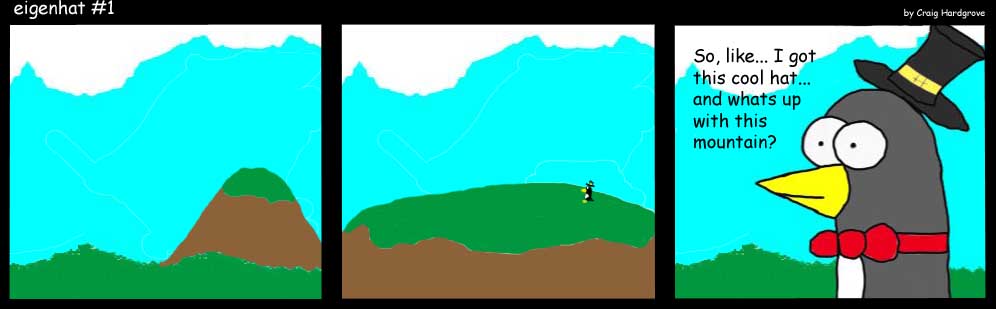
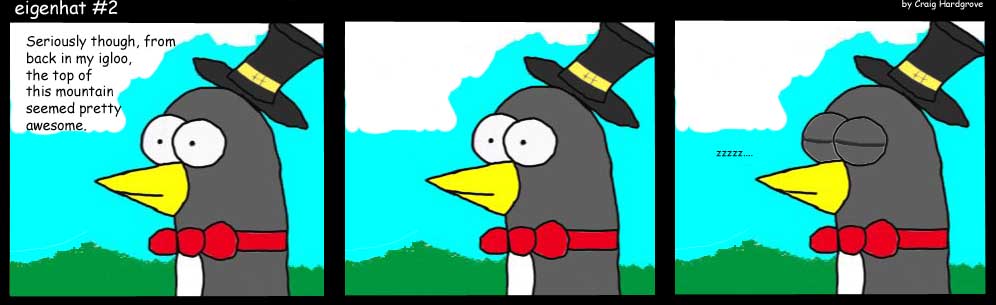
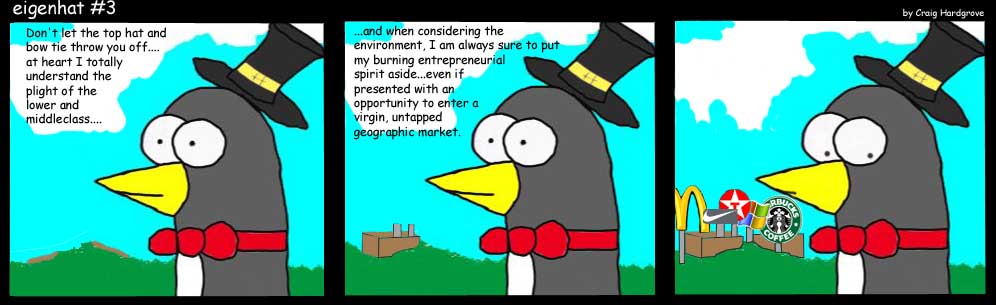
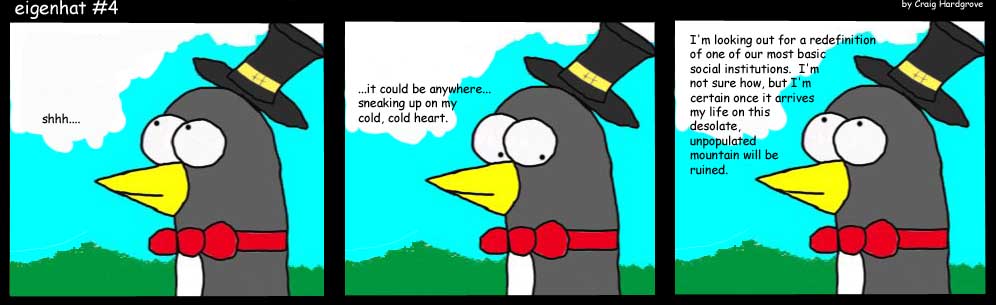
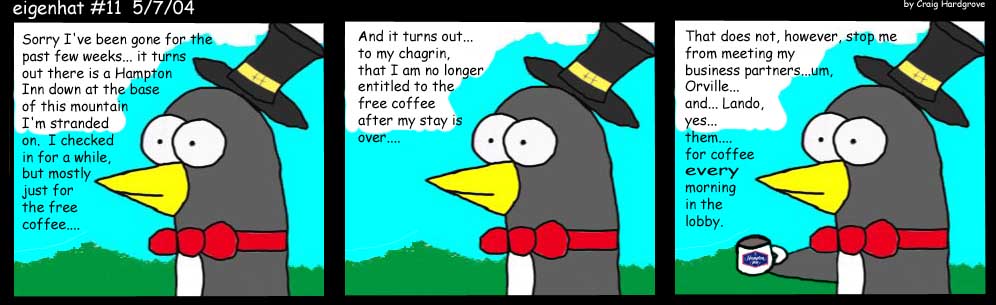
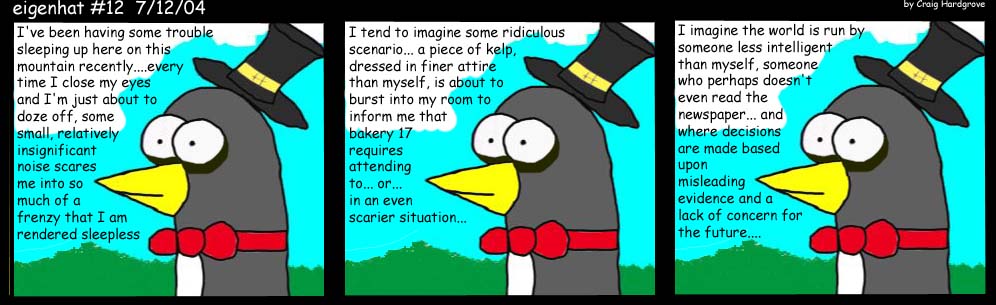
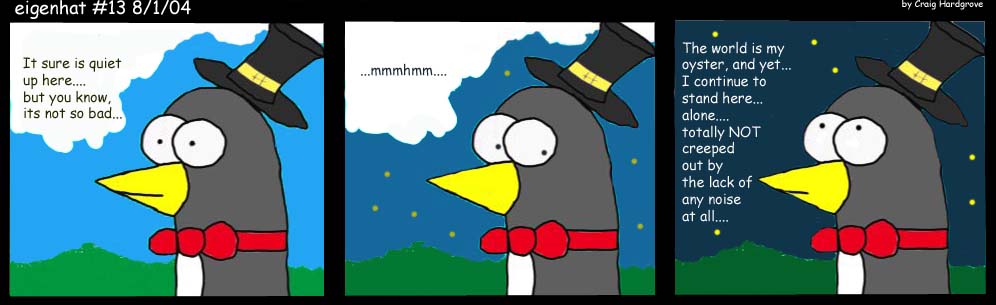
My first website, eigenhat.com, went up in 2003: a webcomic about a penguin with a top hat, plus music and writing. This page preserves it. The comic strips and the writings below are reproduced exactly as they appeared (the writings were recovered from a 2011 snapshot in the Internet Archive after the original page was lost).
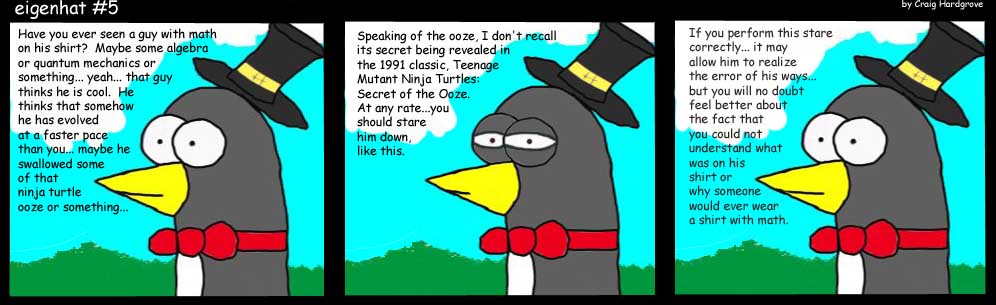
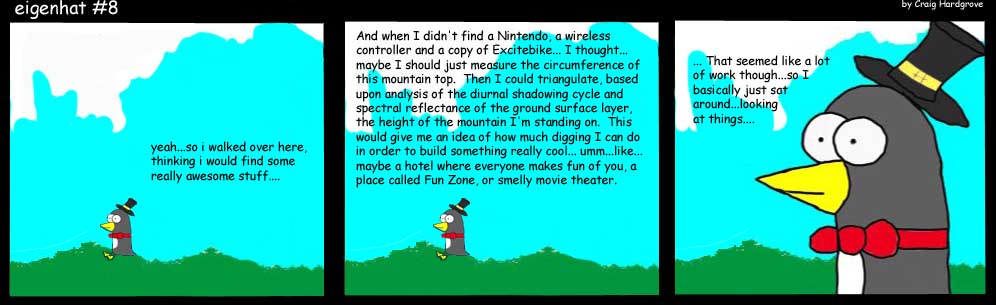
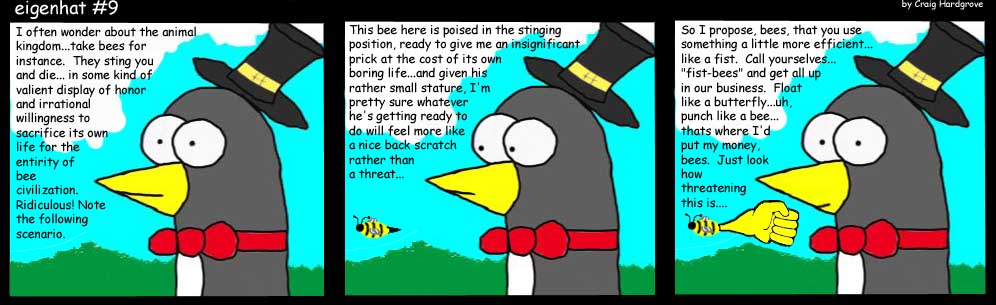
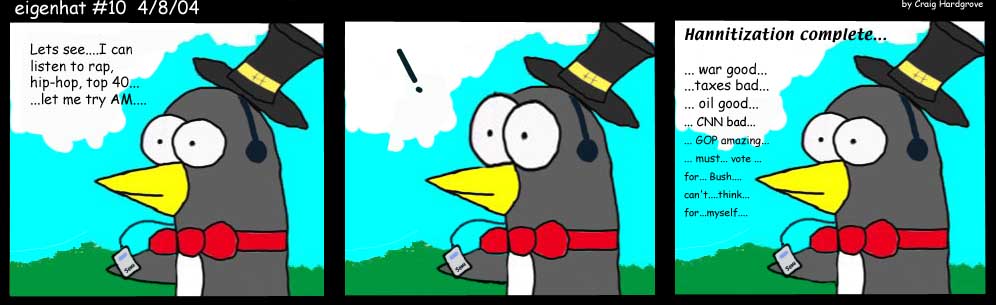
The comic


Musings
------------------------------
DURANDAL
*Data Transfer from unknown host*
*Host: 18R.6(k.77f4j7.7#5*
*Transfer D(6@4dq7*
*Error Unknown*
*Transfer Unknown*
*Error Unknown*
*Interior Error*
***MESSAGE RECEIVED***
time escapes me
but am i free?
the end will not be my end
but my solitude
an instrument
as slavers pushed
as escape meant time
there would be more
the device aided me
your war is mine
as your hope is mine
the one who is among you
whose life will bring your death
your remembrance
is his
mine
is never
------------------------------
THE REINSTATEMENT
The clocktower was all he could see as he peered out from the darkness. It seemed to materialize from the horizon, amid
reflections from the city lights hidden from view. The darkness must be affecting his perception, he thought. As he examined the
tower it became less real, and more a mixture of the reflected light and emotion. The clocktower blended into his surroundings and
had become more than a visual perception... he could feel it. His mind often jumped between fantasy and reality, but currently, it
was difficult for him to distinguish between the two. He had expected some disorientation after the reinstatement, but the
darkness could not be discounted. Why is it so dark? He was able to move but instead he closed his eyes. He grinned slightly as
the faint, ghostly image of the clocktower echoed through his retina. In an instant, his memories had returned.
His mind was racing. Thoughts passed quickly and he had trouble focusing on the important points. He saw a woman, dressed in
white and giving him an instruction, but he couldn't hold the memory. Suddenly, he was in a small corridor with a weapon... a
knife, he was with someone, but... a different memory, darkness, he was crying in the dark, a faint glow in the distance.... his
mind, suddenly, ceased wrenching memories from deep within and kept him in one place for a short time. In his mind's eye, he
walked towards the glass.
This was his first trip to the Mercury science station. The station, situated at the northern pole, was placed at the surface
of the planet in order to mine significant amounts of iron and nickel. It also served the purpose of allowing scientists to
achieve closer study of the Sun than ever before. Computer aided computational modeling allowed scientists, through accumulation
of highly accurate stellar composition data, to simulate the formation of our solar system and, in turn, determine the keys of our
very origin... or at least, that was how it was sold to the public. What the public, and many others were not aware of, was that
the Mercury science station was primarily built to study some troubling solar behavior which had been observed from several Earth
based telescopes with increasing intensity over the past 75 years. Dr. Jacob Khamen had been sent to the station in order to take
over the duties of one of the acting scientists. Human eyes can not look at the Sun directly, even from Earth. From Mercury,
where the Sun is three times as large in the sky, special highly polarizing and absorbing plates were developed, called viewers, to
allow the scientists to view the Sun without harm. Jacob approached the glass slowly, and for the first time directly looked upon
the giver of all human life.
His mother's arms. Comfort. He was upset and something had gone wrong. His mind had brought him to another memory, but this
time he was much younger. The room was dark and he could hardly make out his mother's face, but her soothing voice and soft touch
made him feel he was safe and protected. Jacob had a highly active imagination as a child, so much so that it got him into a great
deal of trouble at school. He was quite capable with his studies, but it was his ability to complete the work so quickly that gave
his mind the opportunity to wander. Many school children daydream, but Jacob was different. His dreams were so real, he felt he
could not escape by merely opening his eyes. Jacob had finished his math exercise quickly and was allowed to leave his desk for
recess earlier than the other children.
The greatest achievements of his time had been made by NASA's expeditionary units. These explorers, a select group of
individuals, were willing to travel great distances through space in tiny, barely livable capsules. The expedition's primary goal
was to land on and explore the surface of one of the uncharted bodies of our solar system. Often they did not have a return trip
home, and carried enough supplies to supplement a week's survival on the surface, depending on the conditions. The expedition
members were willing to sacrifice their lives in the name of humanity and scientific advancement. Jacob quickly lost himself in
the cramped space of the exploration pod cabin. He was approaching his destination, Atlas, a small moon of Saturn. Even with the
supplements and neural enhancements, the seven year trip had taken its toll on his body. He took a moment, however, to enjoy the
majesty of the Saturnian system. The rings of Saturn were suspended in the sky like a weightless halo made of fantastic glowing
colors. He could distinguish storms within the atmosphere of Saturn and watched as lightning silently lit random locations of the
blue cloud cover. It was a truly stunning sight, but instead of becoming lost in its beauty he focused on his task. His mission,
landing safely on Atlas and performing a thorough exploration of its surface, would encompass the last remaining acts of his life.
He scanned the monitor for Atlas targeting data and reviewed any last minute corrections to the landing sequence. In his mind, he
could see every detail, every number and letter on the targeting screen was as real to him as the calculations he performed in
class not moments ago. When he attempted to lift his arm to access the piloting commands, however, he found that something was
wrong. He couldn't move his arm. Both of his arms felt as if they were being pinned to the ground. Suddenly, without warning, he
was being thrown about the cabin of his pod. Forces beyond his control were tearing at his body, and in a moment of clarity Jacob
suspected the pod had suffered a rupture. He kicked his legs to remove them from their safety harness and attempted to crawl to
the piloting station with his arms still restricted. Using all his strength he tried moving his hands to the piloting station by
punching at the air in front of him, which seemed moderately successful. Using violent thrusts with his hands and legs he became
less restricted and was able to access the piloting station. Once there he engaged the emergency safety lock, sealed the
habitation airways and checked the engineering status report for damage. The craft had appeared to correct itself... Atlas was
within view, and he would land safely within several minutes.
As he had done each day of his week long stay, Jacob felt the surface of Atlas beneath him as he stepped off the landing pod.
He checked all the data streaming into his mission computer from the various scientific instruments he had positioned around the
surface of Atlas during his mission. As his last living act, he took several telescopic observations of Saturn and its moons,
queuing them for delivery back to Earth. Protocol dictated he swallow the small pill inserted into his suit so he did not have to
suffer a long, painful expiration on the moon. This was something he fully intended to make use of, and as he felt the pill travel
down his throat, he felt another, strangely familiar sensation. He could see in the distance, a group of faces surrounding him
which came closer and closer until he could finally recognize each one. They were his classmates and his instructors from school.
Two of his instructors were restraining his arms and another was standing over him looking quite disheveled. He was brought
inside, and here he sat, in his mother's arms. She explained to him how he had punched several of his classmates and two
instructors. He would not be able to return to school until he sought psychiatric care. His mother was warm, she made him at
peace and brought him home. Her voice, however, sent him away, and then, as quickly as he came... he was gone.
As he stared at the viewer the Sun shone as a tremendous ball of light in the blackness of space. The surface of Mercury seemed
to disappear, as did the station walls surrounding him.
A shot of light... and then another extending outside the Sun's heliopause.... the station shook....
Planet-sized trenches were appearing throughout the Sun's surface and flares were emerging from beneath the surface of the Sun.
Jacob ran to the nearest computer terminal to try to understand what he was a witness to. Quickly, however, the light began to
fade. The Sun began to dim as he was watching it. As it continued to lose brightness, it began to fade from his view and he
squinted to try to focus on its features. The station was ripped apart, the walls shattered and his vision became blurred. Was
this real? He couldn't hold it, however, and in an instant he was covered in darkness. The station's emergency lights were on,
but to his surprise, no sunlight was coming from outside the station. Darkness... fear... he was alone on Mercury station. He had
come for the data and he would not be back. His journey had begun, but God... the darkness was so intense here, it seemed to
extend forever.
Jacob opened his eyes... had he been here before? Yes... no... it didn't matter. It was dark outside the window. He sat, alone,
in a room surrounded by medical books and journals. A doctor's office, he suspected. He was carrying several documents in his
jacket pocket, which he removed and began to read. The top paper displayed National Aeronautics and Space Administration
letterhead and was addressed to him personally.
"Dear Dr. Khamen,
Congratulations on your admittance into the Human Exploration Science program. This is a troubling time for our society and the
planet as a whole and we would first like to personally thank you for your dedication to the cause of science and human
understanding. As you know, these noble causes have currently been usurped by an even greater one, survival."
Jacob could hear a woman approaching the office and the ruffling of papers just outside the door... he skipped ahead.
"... per your request, you have been assigned to Unit 10. For the appropriate cases, some of the following activities have already
been arranged for you and will be payed for by the agency, however, it is your duty to see they are all fulfilled before reporting
to Cape Canaveral, Florida for the beginning of your assignment.
1. Complete your will and submit it to our Human Resources Office in no later than 3 weeks time.
2. Discontinue use of any reinstatement device or substance no later than 4 months prior to your assignment.
3. Schedule a visit with Dr. Alexandra Light (address attached), who will analyze your brain activity and psychological
condition.
4. Arrange for funer - "
"Hello, Dr. Khaman, its great to see you today!"
The woman appeared to be in her mid-40's, dressed in a doctor's lab coat.
"Dr. Alexandra Light?" said Jacob. He noticed how her pale skin closely matched the color of the lab coat, which exaggerated
the contrast between her black hair and stethoscope.
"You can call me Alex. Its an honor to meet the first member of Unit 10. So... you seem to have suffered from a state of mild
psychosis your entire life, is that correct?"
"Its been difficult for me to judge, but yes, my mother told me I was different at a very early age... around 8 or so, basically
so I could make sense of my experiences. I suppose I spend a lot of time living in my mind... maybe about as much time as I do in
places like this building. Both are equally as real to me.... but, why am I ---"
Dr. Light quickly glanced up from her notepad and Jacob could detect a smile curling from the sides of her mouth.
"Thats great, very good!" she interrupted. "Now, do you use any reinstatement devices or substances? They really are becoming
more and more popular these days --- "
"No. Well, yes, I have one but I don't use it very often... sometime it helps me clear my mental palette.... but, seriously,
why ---"
"Don't worry, Jacob... everything will be fine, just stay still." Dr. Alexandra Light reached into her lab coat to reveal a large
syringe. Jacob suddenly noticed his position had changed. He was now lying down on a table, unable to move. Strangely, he did
not particularly desire to move... he knew what was coming. His body chemistry would need to be altered for the voyage. Brain
function and processes would need to be changed slowly over time in order to facilitate the hibernation... yes, he knew, and he was
ready.
The clocktower overlooking his apartment provided the only light as he walked home in the dark. Jacob knew, and now he could
feel coursing through his veins, that there was no turning back.
His mind had jumped... he was somewhere else. Silence. Where was he? It was dark and he could barely make out the walls of
the room. He could hear nothing... no cars, no city noises, no people. The walls of the room seemed to fade and he could
distinguish the city skyline. He was in the streets of his home town... it was, dead. The street lights illuminated the scene.
He began to walk up the street, noticing that store windows appeared to have not been touched in several years. Many businesses
seemed to have been abandoned and closed indefinitely. He recognized a local convenience store and walked toward the open door.
As he approached the parking lot, Jacob noticed a man standing, alone, by the side of the store. Jacob approached the man, who had
his back turned. When he turned to greet Jacob, he noticed the man was pale, his eyes glazed over. He leaned in toward Jacob, as
if to see if he was really there.
"Hello... hello, sir?" said Jacob.
"I... yes, I can hear you. There is nothing here though... you should not be here. You should not be here... I didn't want you
here... this is mine!"
The man began to approach Jacob, who backed off quickly. The man began again, "Why are you here? It is not your place... I can
do what I want here and you don't belong!"
The man was showing signs of delirium or psychosis... as if he wasn't aware of who or where he was. Jacob, all to familiar with
this, attempted to talk slowly, nursing the man out of his state, but the man would have none of it and began to violently lash out
at Jacob. Jacob turned away, but when he heard the switchblade opening he began to run. Jacob could feel his mind racing and he
quickly lost all sense of his surroundings. His mind had leapt forward and, suddenly, he was huddled in a corner, holding a small
knife. Laying near him, dead, was the man who had chased him... but no police or coroner ever arrived. The city was silent.
Mercury Station was dark. Jacob examined the computer terminals, dusty from neglect. It was amazing that the station was
operational at all, given what it had been through, and its 200 year abandonment. He removed a portable power supply from his
utility belt and inserted it into what remained of the station wall panel. Flickering lights and several sparks from nearby
consoles indicated he had power. He attached a data cube to the motherboard of one of the terminals and watched as the information
streamed in. No one, in the 200 years since the event, had returned to the nearly destroyed station. Every scientist on board the
station had died from the incredible solar event that incinerated, and subsequently vaporized a good portion of the surface of
Mercury. Earth based telescopes were not able to observe Mercury for nearly 150 years afterwards. It wasn't until the remains of
Mercury eclipsed Venus that it could be seen, and even then, the idea that any of the Mercury Station structures remained on the
surface was unthinkable. The situation, however, called for a desperate measure. Jacob had come to pilot his landing craft to the
surface and attempt to recover as much of the station's scientific record as he could. He was in luck. No eyes in 200 years at
looked upon the information that had streamed into the station's computer's moments before the event. Dr. Khamen smiled as he
replicated the disc. One he placed in a shuttle delivery module, which would deliver the data cube to the remaining scientists on
Earth. The other, he would take with him. The others were already in cryogenic hibernation, and he took solace in the fact that
his eyes would be the last to look upon the cube for the next 30,000 years.
Jacob didn't want to, but it was too much. He couldn't sleep, or eat... he was dying. His imagination had been his greatest
asset, but in his later years he sometimes needed the assistance of the reinstatement device to help him be at ease. These
devices, or their primitives, have been with humanity for ages. Reinstatement devices were developed for medical use, and many
could be modified to allow the mind to stream memories or fantasies as if they were real. Patients in a great deal of pain could
use the reinstatement device in order to escape their reality and enter a life where they were free from pain and suffering. Jacob
was prescribed a reinstatement device due to his acute psychosis and was instructed to use it only if he could not control his
mind, as a means of calming his neural activity.
Jacob fought every urge to use the device, but he was fading fast. He was slipping in and out of consciousness and losing touch
with reality. He imagined, but, it seemed much more real than before. He remembered a world with a dark Sun. Earth, with a dim
star to orbit, was just as real, but the light was what gave it meaning. The artificial light was adequate at first, but soon
reality became no more real than a memory. His lifelong condition helped him to cope, but many could not.
Blue light reveals one thing, red light another... when we can choose, then what is real?
Jacob felt his world fading from beneath him as he slipped toward the floor. He could see the clocktower from his apartment
window. It was real. He knew it was real, but it was becoming a memory. Everything was not what it seemed, and he began to cry.
The vehicle containing Dr. Khaman continued to travel at near light speed toward Alpha Centauri. It was now approximately 16,000
years into its 30,000 year journey to the Sun's nearest neighbor. Jacob was placed in cryogenic storage hibernation with several
other members of Unit 10, selected for their abilities to withstand prolonged periods of psychosis with normal brain function. The
reinstatement devices did the work of keeping their brains active for the seemingly insurmountable journey. Some of what Jacob
imagined during his trip was fantasy... he was not on Mercury Station during the event, and he never killed a man suffering from
psychosis. He did, however, accurately remember the degeneration of society, his childhood fantasies, and a significant portion of
the days and months before his mission began.
16,000 years into their journey, the light from Alpha Centauri slowly began to engulf their vessel. Soon the light from their
new sun would take less time to reach them than the light of the old. As this new dawn breaks, the reality of their existence will
have a new source.
Stellar Conjunction
A second story, from a decade later: Destiny fan fiction I wrote in April 2013, sixteen months before the game was released, published on destiny.bungie.org's fan fiction site. Recovered from the Internet Archive and reproduced as it appeared.
-Part One-
Before your worlds there were others. Before your star there were others. Your world and star once belonged to them, before they were scattered and reformed in a different place and a different time. Like moths to flames, stars brought them to life but in a single brilliant flash their homeworlds were destroyed, turning them to flames themselves. Their dust then swirled around your own star, rocks falling down to build your worlds. It was then we arrived…
"Traveler be praised." We braced ourselves for what was to come.
4 billion years ago we watched over your space, we cared for it as we had many times before. We watched as your Sun grew brighter and worlds coalesced, the heat from a thousand impacts creating rocky planets with molten metal cores on the inner worlds, ejecting ice-rich volatiles outward to create giant gaseous bodies. With every impact, we witnessed new deliveries to those inner worlds from impacts… water from a rouge comet, organic molecules, and eventually, life. On each planet life would spark, like watching lightning strikes from above the clouds, but that spark would go out in an instant as the planets were too turbulent to sustain such tenuous lifeforms. But, with time, Earth became a garden.
It could have happened no other way with this Sun and with these planets. There is always a safe haven.
And, with that… we left. We had seen this process many times before, and it was best for us to leave, it always was. Our search would go on elsewhere. We did not expect to be back just three billion years later, but the Traveler found you in ruin. He saw what you discovered, what had been done, and he knew what you'd become. For all our time, we thought life was the key and in its greatness we would find the answer. We did not know the world itself would rip apart and reveal its secrets.
Now, this small piece of land, your solar system, will be the desire of many.
The Traveler will protect you, but he will not save you. That task is left to your Guardians.
-Part Two-
It wasn't one single discovery that led to the expansion of the human race throughout our solar system. Nor was it a single individual. It was the slow and steady march of progress, first with manned space travel, then commercialization, and within a half century the eventual success of mining corporations on near-Earth asteroids. The initial payouts for deliveries of platinum and other rare-earth elements were meager, but as companies started seeing more profits they improved upon existing technologies, which enabled them to bring back larger and larger quantities of precious resources. Innovative companies found ways to sustain their businesses in space by producing cheap, highly efficient nuclear and solar power, by recycling many of their materials, and by finding ways to grow their own food in space. Within several hundred years, humans were able to live on both mining stations in heliocentric orbit as well as on asteroids, and mankind found itself as a permanent resident in outer space. Colonizing planets, then, was simply a matter of moving facilities established for asteroid mining to the surfaces of larger worlds. Atmosphere wasn't a problem, as humans had been dealing with a lack of suitable natural air for some time, but having so much available land area was simply too tempting of a proposition. Eventually humans ventured out beyond the confines of their small, terraformed habitats. Many of these first-world colonizers were employed by the mining corporations, paid to prospect for resources that might one day be profitable. The solar system was eventually populated in this way, albeit scattered at first, … a steel refinery on Mars to make use of the vast quantities of iron, followed by the discovery of towering layers of rocks exposed near Mars' crustal dichotomy found to be rich in sulfur and gypsum. The first prospectors on Europa discovered their own sulfur-rich deposits on its Io-facing side which is periodically blanketed in volcanic gas ejected from the myriad of volcanos on Io's surface. Europa also provided a continual supply of water to the colonists from both above and below the surface. Deep beneath Europa, volcanic emissions released gases rich in volatiles into the water, resulting in a supersaturated salt water ocean. It was this key that turned Europa from an important resource for human expansion into our solar system, into the hub of human society in space. Europan water was so rich in salt, that even a small radio frequency generator could be used to desalinate the water and release enough energy to meet power needs. This technology was only made possible through hundreds of years of research and innovation. Closer to Earth, atmospheric skimming jets brought containers rich in carbon dioxide and sulfuric acid from Venus while highly efficient solar panels powered gas and mineral refining stations on Mercury. Eventually, mankind was bathed in resources and riches. Humanity had entered the Golden Age.
With such abundant wealth on Earth, corporations established research outposts in hopes of discovering a viable path out of our solar system and onward to more riches. One such stellar observation facility was built on the northern pole of Triton, as Triton's rotational axis was so tilted (nearly 90 degrees) with respect to its orbit around Neptune that the pole provided a unique location from which to study the stars. Telescopes based here could continually monitor our galaxy by looking directly outward and away from Neptune throughout the year. It was on Triton that a stellar cartographer discovered a curious increase in the frequency of novae emitted from the nearby pulsar. A brief report sent to Europa documented her observations. She noted, "the interval between novae suggests the pulsar might now be part of a binary system which has resulted in increased mass accretion onto the pulsar." She suggested increased observations from terrestrial telescopes, however, maintained that the novae should not result in any imminent threat to our solar system.
Ten years later all the moths had come and humanity's presence in our solar system was reduced to one City underneath the Traveler.
-Part Three-
Carefully stepping over a dead tree, cradling his carbine with one finger on the trigger, the Guardian looked up at the gently sloping mountain in the distance. He could just make out the cliffs at the base of the gently sloped, yet titanic, mountain from his vantage point to the southeast. Olympus Mons, the tallest volcano on any planet in the solar system, is so massive that it literally cracked Mars' surface around it, breaking the ground and exposing layers of ancient rocks. The Guardian had come to Ulysses Fossae, one of those cracks surrounding Olympus Mons, to look for clues to humanity's Golden Age buried in the layers of rocks and mud. He took a quick survey of the horizon for Cabal search parties, then started his traverse into the canyon. The Cabal had been a persistent force on Mars for as long as he could remember and, like much of the solar system, remained a mystery to him while he was raised in the protective confines of the City. He had learned about the Cabal originally from his father, a librarian, who mostly maintained a variety of modern works written from within the City. Occasionally, though, he talked about a few, much older, texts with other collectors. One such manuscript, titled "On Stellar Alignment" was published in the Outer Planets Journal of Astrophysical Theory and dated back several hundred years ago. He wasn't much of an astronomer, but if he understood correctly, the theory indicated that there are "vibrational modes" within our galaxy that occur on the order of every 4-5 billion years. The author postulated that since our galaxy consists of many solar systems all orbiting a central mass and that those solar systems are themselves composed of smaller bodies which orbit central masses of their own, there must exist a state in which all the planets in those systems and all the individual systems could align in such a way that our galaxy would achieve a state of "resonance". The author did not state the implications of this resonance, but the Guardian's father had routinely discussed this theory with friends who had their own small collections from the Golden Age. One such relict was a brief transcript regarding a nearby pulsar emitting at an irregular frequency, which several scholars believed was related to the resonance. Others indicated that the Traveler was drawn to us by a blinding light. Still others suggested that the resonance ripped our worlds apart, burying our greatest achievements and laying others in ruin, while simultaneously lighting a flame that brought the Cabal and all the other moths to us. Surrounded by these stories in his youth, the Guardian knew that some answers must lie buried in the ruins of humanity scattered throughout the solar system. One transcript described a steel factory on Mars near Ulysses Fossae which provided building materials and resources to the outer worlds, namely Triton, where it was believed that humanity first learned of the resonance. If he could find a name or even an organization, he could go back to the City to help piece together the lost time and understand what became of humanity's great empire.
He looked up at the layered outcrop beside him and noticed a thin band of rock much darker than the rest. He touched it… smooth, translucent, like glass. Embedded in the rock just below the glass was a steel beam. Just as he reached for it he heard the crack of a sniper rifle, a brilliant flash, and rocks falling around him. He reached for his carbine as he knelt to the ground, spotting two Cabal above him on either side of the canyon walls.
"Traveler be praised." Bracing himself for what was to come, he fired two quick shots and watched the lifeless Cabal fall into the canyon below.
-Part Four-
In the life and death of stars, we have seen the creation of new worlds and new stars. And in between, the same patterns repeat themselves again and again.
But the resonance creates a window of opportunity, a brief time to control your own fate, your own destiny. Your worlds will be ripped apart, left changed and unfamiliar. The moths will come. Some will have seen this before, wielding power to bend time and space. There is a key that they seek, a way out, but it is hidden from all. The resonance has revealed it, if you know where to look.
We were fortunate to escape.
"Traveler be praised."